
Finding Truth Matters, home > articles > theology > The Imago Dei Revealed Through Genesis, Part 4 – Effects of the Fall
The Imago Dei Revealed Through Genesis, Part 4 – Effects of the Fall
by Dr. Andrew Corbett, 22 February 2026, from Melbourne, Australia
The imago Dei is much more than an ancient Hebrew concept of what constitutes the essence of a human being. It has been embraced by many, if not most, western governments to become the grounding for how western civilisation regards human rights. Examples of this include the United Nations Declaration of Human Rights – “Whereas recognition of the inherent dignity and of the equal and inalienable rights of all members of the human family is the foundation of freedom, justice, and peace in the world” and, the The 1776 United States Declaration of Independence – “We hold these truths to be self-evident, that all men (sic) are created equal, that they are endowed by their Creator with certain unalienable Rights, that among these are Life, Liberty and the pursuit of Happiness.” The imago Dei concept has been described by Prof. Ellen Davis (Duke University Divinity School) as “potent yet cryptic” (Davis 2019, 9). This is part of the reason why systematic theology is insufficient in adequately understanding this literary figure. Much of the scholarship about the Genesis 1:26-27 introduction of the imago Dei has primarily focused on the man (A’dam). Yet, this introduction describes God creating the imago Dei as male (Heb. zakhar) and female (Heb. neqevah) — that is, not just as an individual, but in the plural. Rather than regarding Genesis 2 as an alternative account of creation, it should be seen as providing the detail of Genesis 1:26-27 introduces. Before we can consider the effects, if any, of the Fall of humankind from innocence, we must reflect on how this detailed account influences our understanding of the effect of the Fall.
The Genesis 2 Creation Account of the Imagines
18) ¶ Then the LORD God said, “It is not good that the man should be alone; I will make him a helper fit for him.” (19) Now out of the ground the LORD God had formed every beast of the field and every bird of the heavens and brought them to the man to see what he would call them. And whatever the man called every living creature, that was its name. (20) The man gave names to all livestock and to the birds of the heavens and to every beast of the field. But for Adam there was not found a helper fit for him. (21) So the LORD God caused a deep sleep to fall upon the man, and while he slept took one of his ribs and closed up its place with flesh. (22) And the rib that the LORD God had taken from the man he made into a woman and brought her to the man. (23) Then the man said,
“This at last is bone of my bones
and flesh of my flesh;
she shall be called Woman,
because she was taken out of Man.”
(24) ¶ Therefore a man shall leave his father and his mother and hold fast to his wife, and they shall become one flesh. (25) And the man and his wife were both naked and were not ashamed.
Genesis 2:18-25
Because the imago Dei is introduced in Genesis 1 and then detailed in Genesis 2 in the plural, I am adopting Brent Strawn’s terminology of imagines to refer to the plurality of the imago Dei; and, from this point I will use the imago for imago Dei. As we consider the possible impact of the Fall on humankind’s standing as imago as plural will be seen as critically important. I have already alluded to the reasons for this in the previous chapter on fallacies. It is important to appreciate that the account of the creation of the first man and the first woman is not an alternate creation story — it is the detail of what is introduced in summary in Genesis 1. And this point is profoundly important because it reinforces something essential to our proper understanding of the imago.
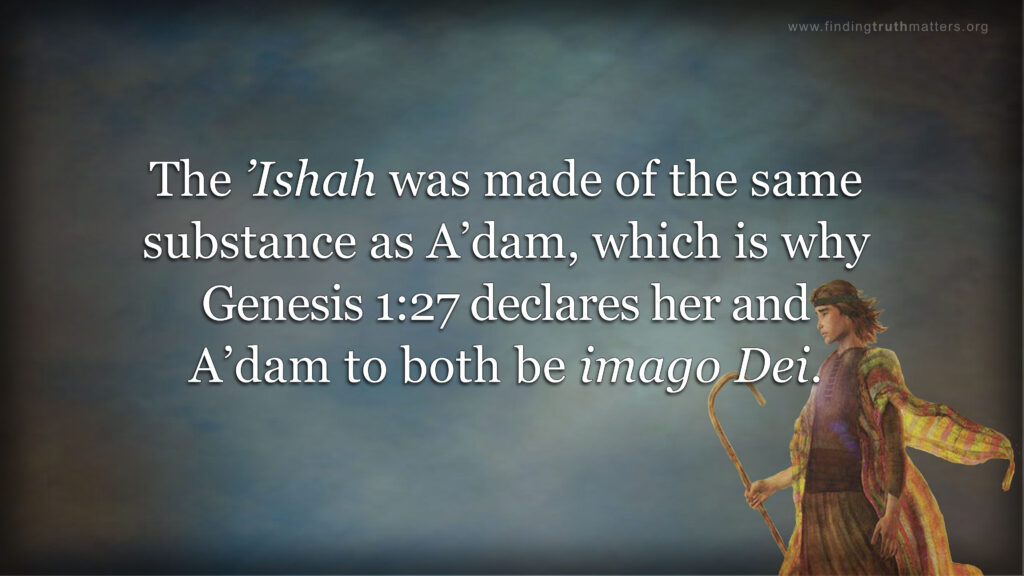 I generally do not refer to the created woman in Genesis 2 as ‘Eve’. Rather I refer to her with the designation that Genesis 2 assigns to her: ’Ishah. (In Genesis 3:20, which is after the Fall, Adam renames her as ‘Eve’.) I feel this is an important point – especially in our quest to understand the imago. When God took something out of Adam, which the text refers to as a rib, GOD used that substance to create ’Ishah. That is, the woman was created of the same substance, that had been God-breathed, as Adam was. This divine breath is unique to humankind. The Hebrew expression (Hebrew, neshmat chayim) occurs nowhere else in the Bible. Many commentators have recognised that this surely is an indication and a marked of humankind’s unique status among God’s creatures. David Clines states, “There is perhaps in the concept of the ‘image’ a slight hint of the limitation of the status of humankind, in that the image is not itself the thing it represents and that the copy must in some respects be unlike its original” (Clines 1998, 447-97). John Swann similarly states, “The image of God, on the other hand, is clearly given as a unique status and suggests a separation from and superiority to the animal kingdom” (Swann 2017, 21). This means that there is a link between how the first man and the first woman were substantively created that gives them a unique status. Their fall from innocence had no bearing on their substance and therefore also had no bearing on their unique status.
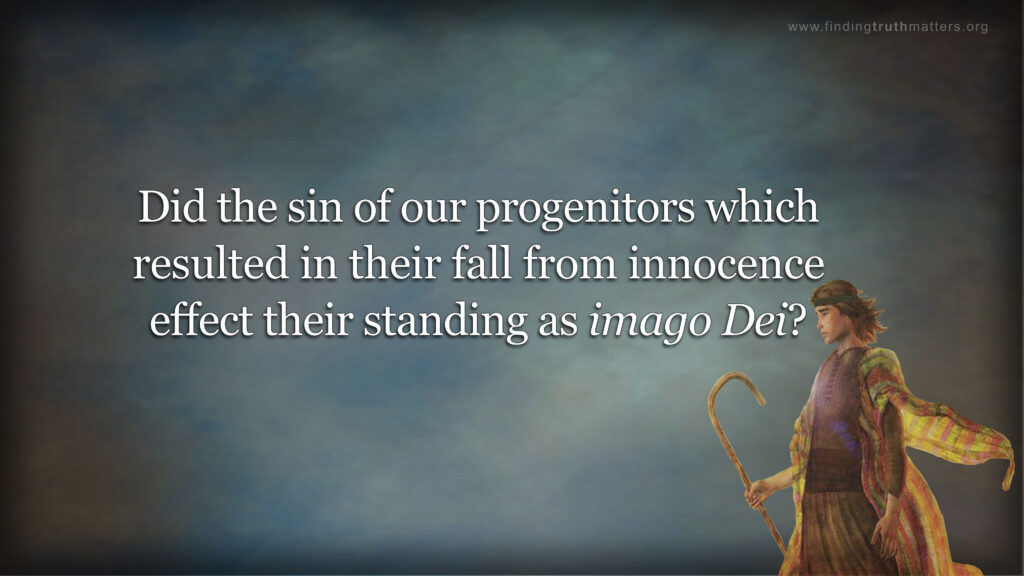
The creation of the woman described in Genesis 2 was the completion of the man and the means by which he could fulfil his consequences of being an imagine. Naturally, the preceding creation of the man also meant that the woman could fulfil her consequences of being an imagine. As we have noted in the third part of this series, it is a fallacy to claim that because the woman was created subsequent to the man, or that because she was first to yield to the serpentine temptation, that she was either never really created as an imagine or that her imagine status was lost or diminished when she sinned.
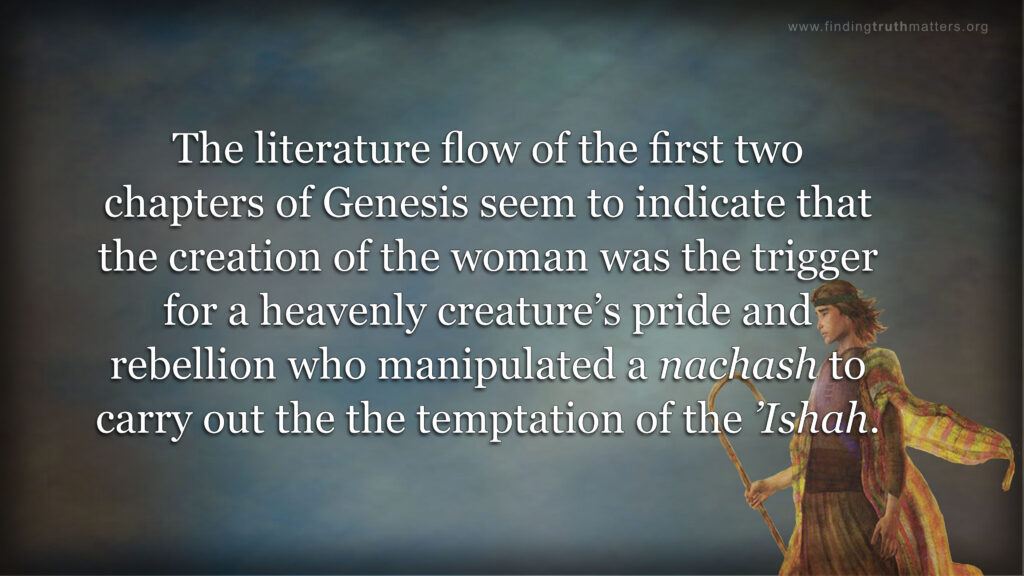 What is also overlooked about the creation of the woman is that her creation was the trigger for a heavenly creature’s pride and rebellion who then orchestrated to manipulate a nachash (serpent) to be able to speak and carry out the the temptation of the ’Ishah (Gen. 3:1). Perhaps there was a recognition that Yahweh had now created a being who was uniquely powerful. While other creatures could create after their own kind, Yahweh had now created a being who could also create imagines. This is something that no heavenly creature could do, and it seems that one of these heavenly creatures was filled with envy and desired to sabotage what Yahweh had created to image Him.
The Nascent Creation of the Imagines
When the first man and the first woman were created as imagines there were not yet what they were created to be. They were created as nascent. ‘Nascent’ refers to something that is, but is not all that it is yet meant to be. John Kilner writes that there are two categories of persons who are referred to as “image of God.” The first category are the imagines, that is, humankind. The second category is Jesus Christ Himself. Kilner remarks about the identification of humans and Christ with the imago: “Humanity and Christ both have a special connection with God. They also presently (Christ) or ultimately (humanity) are a reflection of God” (2015, 59). But he highlights some clear distinctions about how the imago designation refers to humankind and Christ. “God intends people ultimately to become the ‘likeness’ of God, where the special connection with God and the reflection involved entail similarity rather than identity. Christ, however, is an ‘exact imprint’ of God (‘charakter,’ Heb. 1:3). So whereas God intends people ultimately to be a ‘likeness-image,’ Christ is an ‘imprint-image’.” This, Kilner continues, “means that Christ constitutes a complete picture of what God intends for people in God’s image to be and to do” (Kilner, 60). Thus, humankind were created to become the imagines of God, whereas Christ is the imago. This is further highlighted by the bible’s use of prepositions whenever it speaks of humankind as imagines (Gen. 1:27 “So God created man in his own image”); yet, in contrast to this, the bible uses the definite article when speaking of Christ as the imago of God (Second Corinthians 4:4, “Christ, who is the image of God.”).
 What effect did the Fall have on humankind’s status as imagines? Initially, Augustine was quite emphatic that it was catstrophic: “by his sin Adam lost the image of God in which he was made,” (Augustine, De Genesi ad literam, written in the early years of the fifth century. vi.27f). But toward the end of his life he seems to have changed his mind and retracted his earlier statement: “should not be taken to mean that none [of the image] remained in him, but that it was so deformed that it was in need of reformation” (Retractations ii.24. Augustine died in 430 before this retrospective survey was completed). However, his initial comments about the effect of the Fall on humanity’s standing as imagines was profoundly influential on later theologians.
![“by his sin Adam lost the image of God in which he was made,” - Augustine, De Genesi ad literam (written in the early years of the fifth century) vi.27f. - “should not be taken to mean that none [of the image] remained in him, but that it was so deformed that it was in need of reformation.” - Retractations ii.24. Augustine died (in 430) before this retrospective survey was completed.](https://www.findingtruthmatters.org/wp-content/uploads/2026/03/IDRTG-Pt04-37-1024x576.jpg)
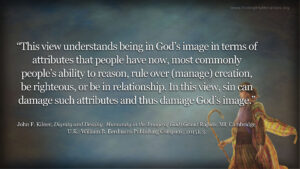
Kilner criticises Augustine’s view of the effect of the Fall humankind’s standing as imagines – both Augustine’s earlier and later views, because:
“This view understands being in God’s image in terms of attributes that people have now, most commonly people’s ability to reason, rule over (manage) creation, be righteous, or be in relationship. In this view, sin can damage such attributes and thus damage God’s image.”
John F. Kilner, Dignity and Destiny: Humanity in the Image of God. 2015, 3.
The imago status of humankind was conditional or the result of fulfilling certain consequences, therefore, when our progenitors committed the original sin, they remained in their imago status. “[A]ll that is true about humanity is not necessarily true about God’s image. For instance, just because sin has damaged humanity does not logically require that it has damaged God’s image. Everything that is true of one is not necessarily true of the other” (Kilner 2015, 45). Yet, because their ontological destiny was always intended to be fulfilled as they were ultimately conformed into the true imago of Christ, their Fall into a sinful nature has hampered their destiny. This is why the New Testament continues to regard humanity as being in the imago yet needing to be redeemed, justified, and glorified into the likeness of Christ to reach our ultimate purpose.
For those whom He foreknew He also predestined to be conformed to the image of his Son, in order that He might be the firstborn among many brothers…. Do not be conformed to this world, but be transformed by the renewal of your mind, that by testing you may discern what is the will of God, what is good and acceptable and perfect.
Romans 8:29; 12:2
References
Clines, David J. A. ‘Humanity as the Image of God’, On the Way to the Postmodern: Old Testament Essays, 1967–1998, vol. 2, Journal for the Study of the Old Testament Supplement Series, 293; Sheffield: Sheffield Academic Press, 1998
Davis, Ellen F. Opening Israel’s Scriptures. New York: Oxford University Press, 2019.
Kilner, John F. Dignity and Destiny: Humanity in the Image of God. Grand Rapids, MI; Cambridge, U.K.: William B. Eerdmans Publishing Company, 2015.
Swann,.John Thomas. The Imago Dei: A Priestly Calling for Humankind. Eugene, OR: Wipf and Stock, 2017.
-
Sale!

AUTHENTIC APOSTOLIC LEADERSHIP – Biblical Structure for the Church Today
Original price was: $18.95.$14.95Current price is: $14.95. -
Sale!
THE MOST EMBARRASSING VERSE IN THE BIBLE
Original price was: $11.95.$7.95Current price is: $7.95. -
Sale!

CHRISTIANISED WITCHCRAFT – Getting things wrong in Jesus’ Name, eBook
Original price was: $7.95.$5.95Current price is: $5.95. -
Sale!

THE MOST EMBARRASSING BOOK IN THE BIBLE, Understanding the Book of Revelation – eBook
Original price was: $15.95.$8.95Current price is: $8.95.

© Finding Truth Matters - Public Policy - Ethics - Cultural Commentary - Philosophical-Biblical-Theology - Apologetics
0 Comments